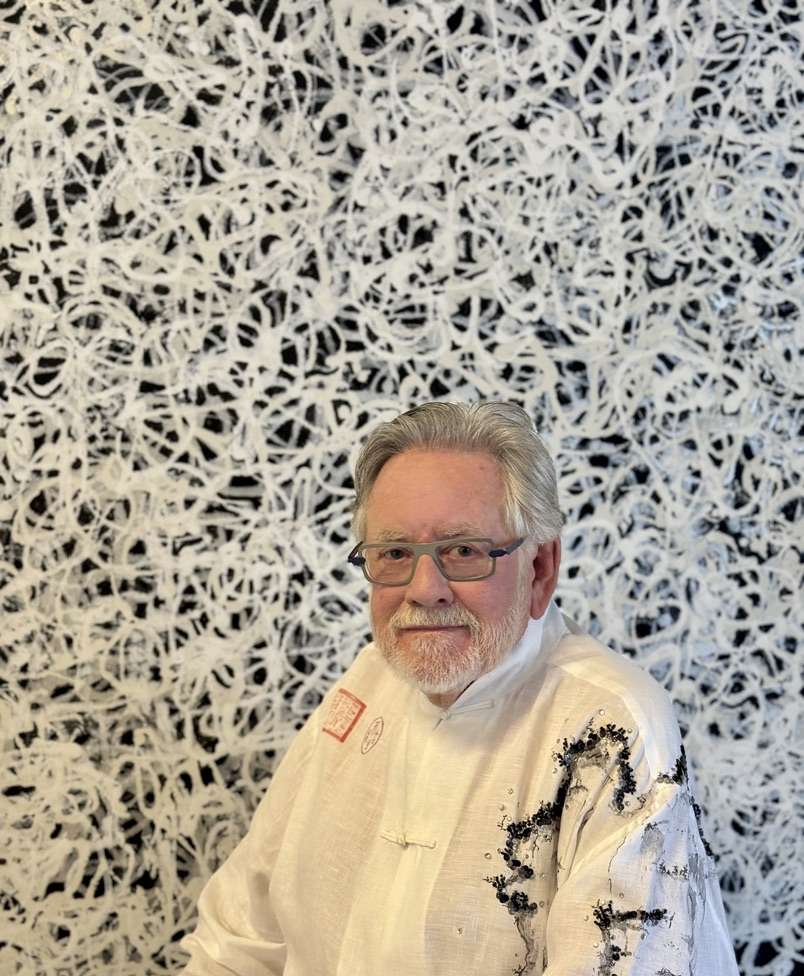
Gregory Ladner: A journey from couture to canvas
Earlier last month, renowned Australian couturier and accessory designer Gregory Ladner brought his first major solo exhibition, Hidden Figures, to our gallery here at West End Art Space.
The show marked a new chapter in Ladner’s creative life; one that bridges his celebrated fashion career with his lifelong passion for painting. The gallery became the setting for a remarkable artistic chapter in the life of a designer whose influence has long shaped Australia’s fashion landscape. Known for decades as a refined, imaginative force in the world of couture and accessories, Ladner stepped into the realm of visual art with a series that felt both intimate and strikingly expressive.
Hidden Figures became a moment of return and rediscovery; the continuation of a creative journey that began long before Ladner entered the fashion world.
A Life Shaped by Design
Gregory Ladner’s fashion career had always been marked by an unerring eye: a sensitivity to colour, an instinct for structure, and an understanding of how texture, line and form can play together to create beauty. These qualities, which shaped his design practice for so many years, were instantly visible in his paintings.
Retirement from fashion did not quiet his creativity – it redirected it. Painting became a natural extension of the same impulses that once guided his hands as he shaped garments and accessories. The transition from couture to canvas felt like a continuation rather than a departure: a new medium, but the same maker, still attuned to elegance and expression.
The Opening Reception: A Full House and a Warm Welcome
The exhibition opened to a packed and enthusiastic audience, with well over 120 guests attending the reception. Collectors, artists, friends, long-time admirers of Ladner’s fashion work and new supporters of his painting practice filled the gallery.
The atmosphere buzzed with warmth and curiosity as visitors lingered over the works, pointed out emerging shapes, and shared their interpretations with one another. Many noted how seamlessly his fashion sensibilities had translated into a painterly language – structured, balanced, refined, yet full of movement.
The opening night not only celebrated Ladner’s artistic evolution but also demonstrated how deeply his creative spirit resonates across different artistic communities. It was an evening that acknowledged his legacy while also embracing his new direction.
About the Exhibition: When Figures Revealed Themselves
Hidden Figures presented a collection built on discovery. At first glance, the works appeared abstract: layered colour, bold brushwork, and textured gestural marks. But as viewers looked more closely, something shifted. Delicate outlines appeared. Faces emerged. Figures took shape, then dissolved, then re-formed elsewhere.
These “hidden figures” were never fixed; they changed as the viewer’s eye adjusted. Some saw a face immediately; others saw pure abstraction until a second or third encounter. The paintings rewarded patience, inviting visitors to slow down and look again. This gentle playfulness – the quiet invitation to discover – became one of the exhibition’s defining qualities.
Echoes of Fashion in Paint
Those familiar with Ladner’s design career immediately recognised familiar sensibilities. Beneath the apparent spontaneity of the brushwork lay structure and balance, reminiscent of the discipline required in couture. The paintings
often felt layered like fabrics – folded colours, overlapping shapes, forms emerging as though from beneath a draped textile. Ladner’s long experience in fashion infused his canvases with an unmistakable sense of composition. The transfer of skill from cloth to canvas felt natural, as though the two practices were chapters from the same creative book.
A story of reinvention and return, perhaps the most touching aspect of Hidden Figures was the sense of coming home. Painting had been one of Ladner’s earliest artistic loves, and this exhibition marked a return to that foundation. Yet the work did not carry the heaviness of reinvention – instead, it radiated joy, experimentation and ease. The exhibition felt like an artist giving himself permission to explore, to play and to follow instinct. In this sense, Hidden Figures became a portrait of reinvention not as an upheaval, but as a gentle unfolding.
The Viewer in Conversation with the Art
One of the striking scenes repeated throughout the exhibition period – especially on opening night – was the way viewers gathered around the works in small groups, pointing and engaging with the shifting forms.
“Do you see it?” became a common question whispered between guests. Some spotted figures immediately, while others needed time before the shapes revealed themselves. This participation became part of the artwork itself – a collaboration between artist, canvas, and audience.
It was clear that the paintings did more than simply present themselves; they invited viewers into the act of seeing.
A Memorable First Solo Exhibition.
Hosting Gregory Ladner’s first solo exhibition was an honour for West End Art Space. Hidden Figures not only introduced audiences to his painterly voice but also celebrated a lifetime of creative evolution expressed through a new medium.
The exhibition became a testament to continuity: proof that creativity can shift, stretch, and transform but rarely disappears.
Ladner’s work invited visitors to slow down, look deeply, and discover the subtle forms that linger beneath the surface. It was a deeply personal, beautifully executed exhibition, and its success — marked by a vibrant opening and strong audience engagement — affirmed the power of art that invites us to see differently.
